HTTP, REST, JSON & Status Codes — Cheat Sheet
An evergreen reference for the whole API pass. These concepts are first taught in API Lesson 1 ("How Web Apps Talk"); keep this open whenever you're building or testing an endpoint. Nothing here is stack-specific — it's true of every web API.
HTTP: a request, then a response
Every interaction between a client (a browser, your React app, or Insomnia) and a server is one request and one response over HTTP.
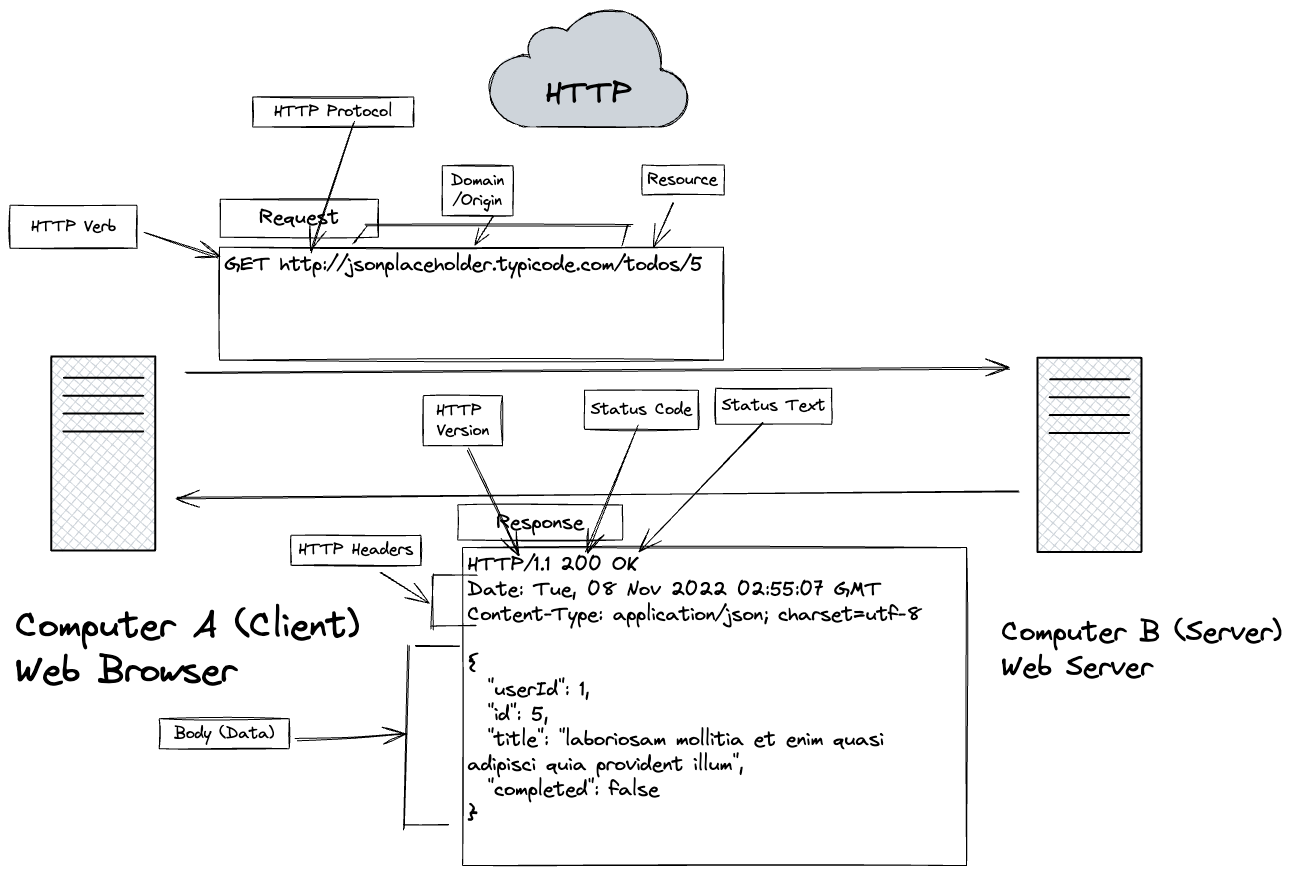
The request is made of:
| Part | Example | What it is |
|---|---|---|
| Verb (method) | GET |
the action — GET, POST, PUT, DELETE |
| Protocol | http:// / https:// |
how to talk to the server |
| Domain / origin | jsonplaceholder.typicode.com |
which server |
| Resource (path) | /todos/5 |
which thing on that server |
| Headers | Content-Type: application/json |
metadata about the request |
| Body | { "title": "..." } |
the data sent (POST/PUT only) |
The response is made of:
| Part | Example | What it is |
|---|---|---|
| HTTP version | HTTP/1.1 |
the protocol version |
| Status code | 200 |
the numeric outcome (see below) |
| Status text | OK |
the human-readable outcome |
| Headers | Content-Type: application/json |
metadata about the response |
| Body (data) | { "id": 5, ... } |
the data returned, usually JSON |
REST: resources and verbs
A REST API models everything as resources (nouns) addressed by URL, and uses HTTP verbs to act on them. One resource, four verbs:
| Operation | Verb | URL | Success | Not found | Bad request |
|---|---|---|---|---|---|
| Read all | GET |
/api/staff |
200 OK | — | — |
| Read one | GET |
/api/staff/5 |
200 OK | 404 | — |
| Create | POST |
/api/staff |
201 Created | — | — |
| Update | PUT |
/api/staff/5 |
200 OK + body | 404 | 400 |
| Delete | DELETE |
/api/staff/5 |
204 No Content | 404 | — |
This table is the contract every controller in this course honors.
Resource-URL rules of thumb:
- The collection is /api/{resource} (plural) — /api/orders.
- A single item is /api/{resource}/{id} — /api/orders/5.
- A custom action on an item uses this course's convention /api/{resource}/{id}/{verb}
— id before verb — e.g. PUT /api/orders/5/cancel.
JSON: the data format
JSON (JavaScript Object Notation) is how the body is shaped — a set of
"key": value pairs. Values can be strings, numbers, booleans, null, arrays, or
nested objects:
{
  "id": 5,
  "tableNumber": 12,
  "status": "PLACED",
  "total": 42.95,
  "orderItems": [
    { "id": 1, "quantity": 2, "menuItem": { "name": "Loaded Nachos" } }
  ]
}
Your API sends and receives JSON; the C# side turns C# objects into JSON on the way out and JSON back into C# objects on the way in (that's model binding).
Status codes: the outcome in a number
Every response carries a status code — a three-digit number grouping into five families. Learn the families and you can read any response at a glance:
| Family | Meaning | Whose "fault" |
|---|---|---|
| 1xx | Informational | — |
| 2xx | Success | it worked |
| 3xx | Redirection | look elsewhere |
| 4xx | Client error | your request was wrong |
| 5xx | Server error | the server broke |
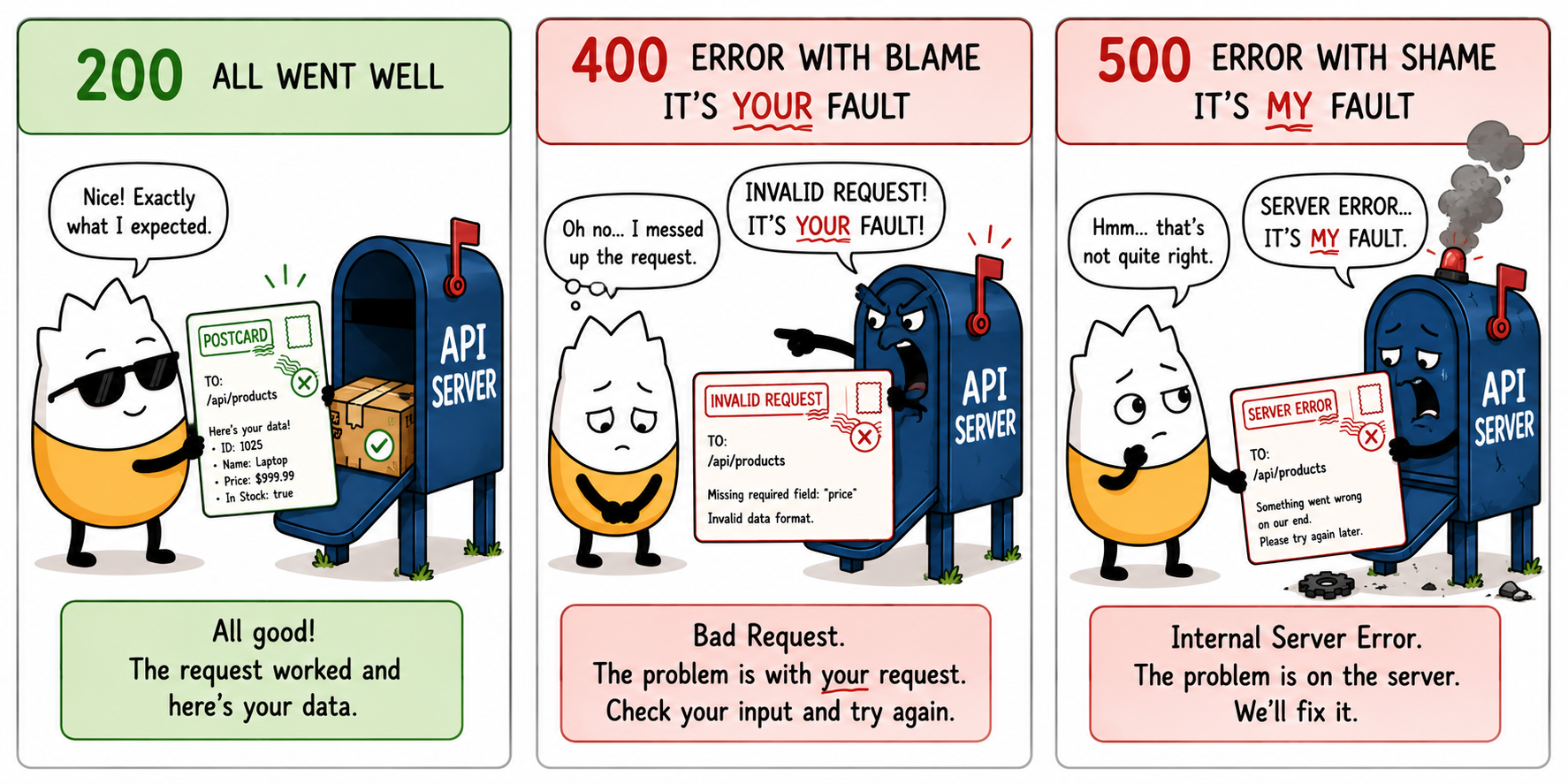
The quick mental model: 2xx = all good, 4xx = you messed up the request, 5xx = the server messed up.
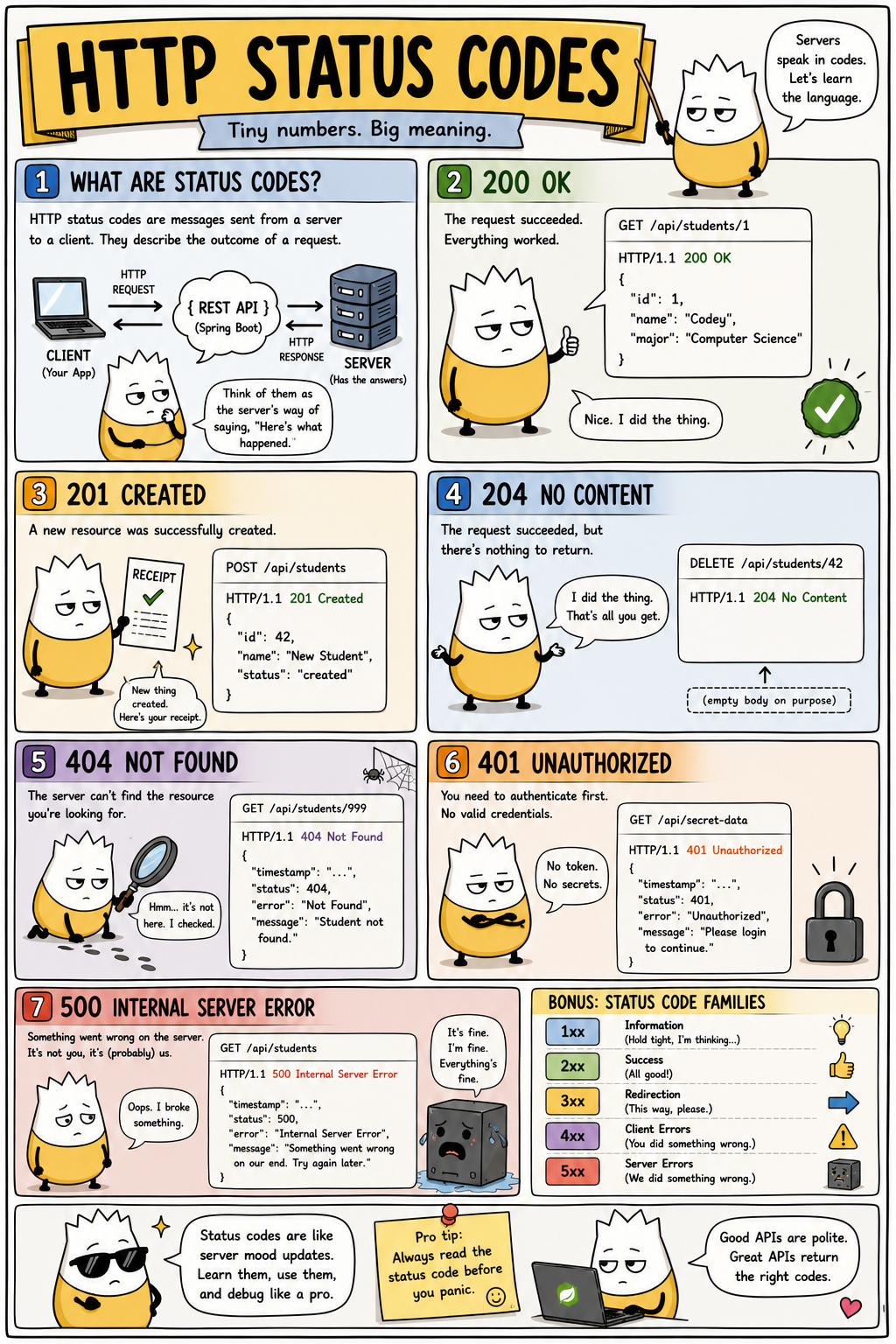
Two notes for this course when reading the infographic above: - It labels the server "Spring Boot." Our API is ASP.NET Core — the HTTP concepts are identical regardless of the language the server is written in. - It shows
401 Unauthorized. This course has no authentication — every endpoint is open, login just returns the user object, and there are no tokens — so you will never see a 401 here. It's shown for general awareness only.
The codes you actually use
These six are the entire vocabulary of this course's API:
| Code | Text | When |
|---|---|---|
| 200 | OK | a successful GET / PUT (with a body) |
| 201 | Created | a successful POST (returns the new item + Location) |
| 204 | No Content | a successful DELETE (empty body) |
| 400 | Bad Request | the request was malformed (e.g. URL id ≠ body id on PUT) |
| 404 | Not Found | no resource with that id |
| 500 | Internal Server Error | an unhandled exception on the server |
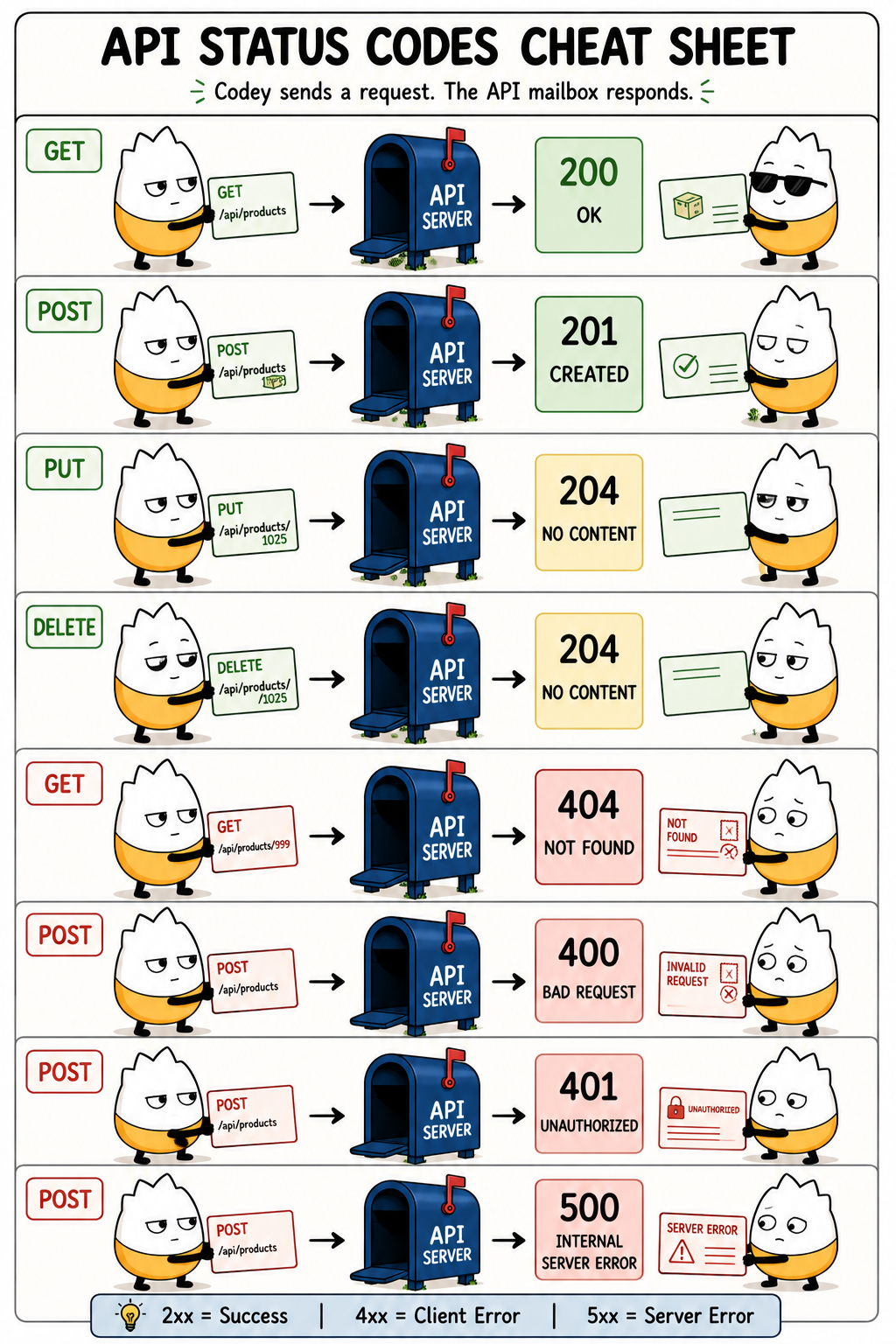
Same caveat: the sheet above includes a
401 Unauthorizedpanel. There's no auth in this course, so that case doesn't occur here — everything else on the sheet is exactly what your API returns.
Learn more
- HTTP response status codes — MDN — the authoritative list of every code and when to use it.
- Web Application Architecture — handsonreact.com — where the client, server, and API sit in a single-page app.
- JSONPlaceholder — a free live fake REST API you can hit from Insomnia to practice reading requests and responses.